

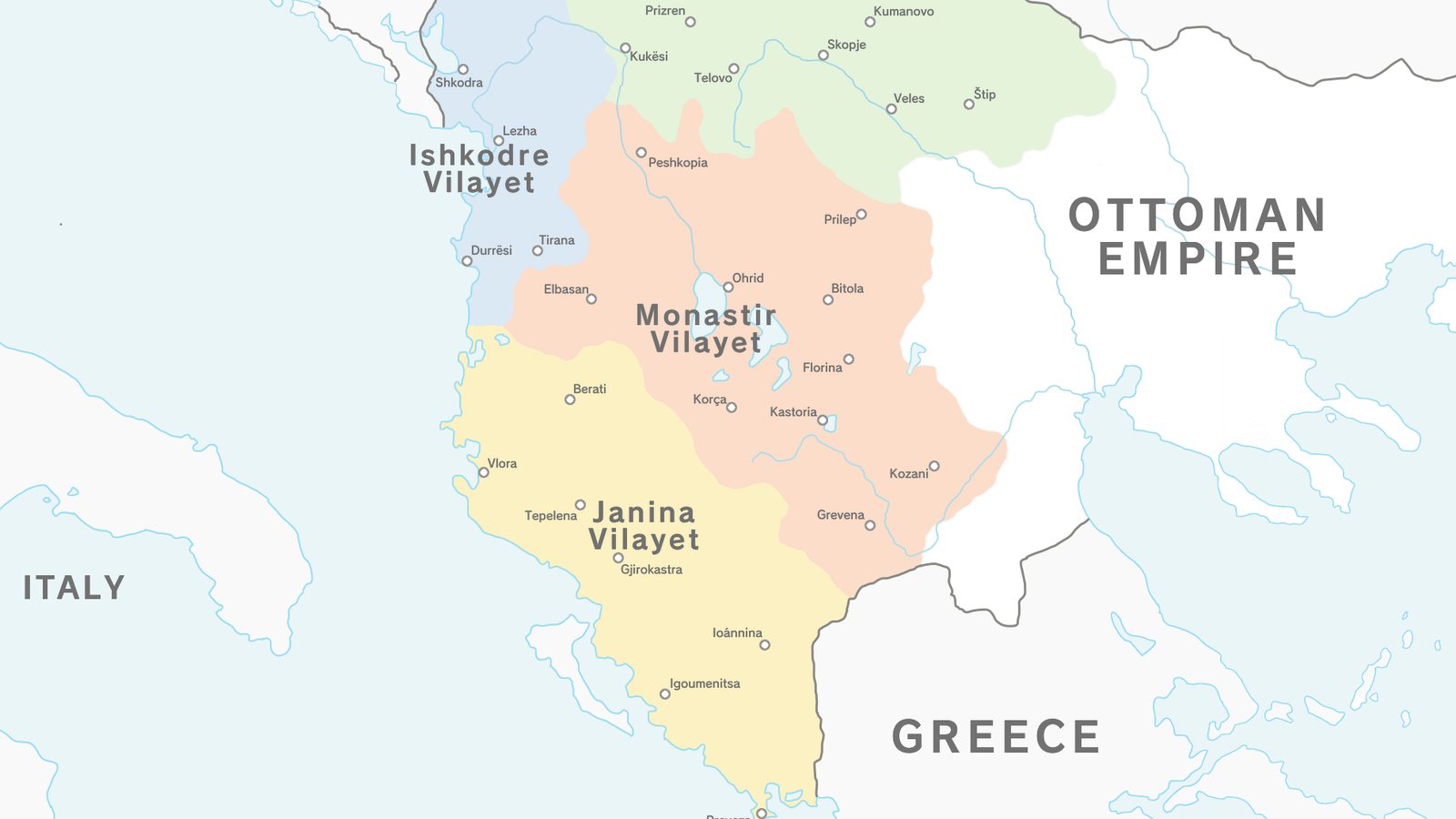
On 10 June 1878, while diplomats from the Great Powers convened in Berlin to redraw the map of the post-Ottoman Balkans, Albanian delegates gathered in a stone building in Prizren — a city in what was then the Kosovo Vilayet of the Ottoman Empire — and did something no Albanian assembly had done before. They organized across religious lines, across regional lines, across the clan boundaries that had defined Albanian politics for centuries, and declared that Albanian-inhabited land would not be handed to the neighbors without a fight.
The organization they founded — the League of Prizren, or Lidhja e Prizrenit — lasted only three years before Ottoman troops crushed it. But in those three years it became the first Albanian political-military organization in history, the first body to demand that all Albanian-inhabited territory be governed as a single unit, and the political ancestor of every Albanian national institution that followed. The broader story of the Albanian Renaissance spans decades; the League is its sharpest single episode.
The crisis that forced the question
The immediate trigger was the Treaty of San Stefano, signed on 3 March 1878 at the end of the Russo-Turkish War of 1877-78. Russia, having defeated the Ottoman Empire, imposed terms that redrew the Balkans in its favor. The treaty created a large autonomous Bulgaria stretching from the Danube to the Aegean and from the Black Sea to territories that included parts of present-day southeastern Albania. It enlarged Serbia and Montenegro at Ottoman expense. And it assigned to Montenegro the districts of Plav, Gusinje, Podgorica, and the Albanian-inhabited coastal town of Bar (Antivari) — plus the port of Ulcinj.
For Albanians, the treaty was a map drawn without them. The lands it reassigned were home to Albanian-speaking populations who had not been consulted. The congress that followed in Berlin (June-July 1878) revised many of San Stefano’s terms — shrinking the proposed Bulgaria, adjusting borders — but it did not consult Albanian representatives either, and its own map still ceded Albanian-inhabited areas to Montenegro and Greece.
The Albanian response was the League.
The founding: 10 June 1878
In the spring of 1878, as it became clear that the Great Powers intended to partition Albanian lands regardless of Albanian opinion, Abdyl Frashëri — the eldest of the three Frashëri brothers, an Ottoman parliamentary delegate from Janina, and the most politically experienced Albanian leader of the period — organized a secret committee in Istanbul to coordinate a response. He was not alone: Albanian notables, beys, and community leaders from across the four Ottoman vilayets where Albanians were the majority or a large minority — Kosovo, Shkodër, Manastir (Bitola), and Janina (Ioannina) — recognized the threat.
On 10 June 1878, delegates from across the Albanian-inhabited lands convened in Prizren. The gathering was remarkable for what it overcame. Albanian society in 1878 was divided by religion (roughly 70% Muslim, 20% Orthodox, 10% Catholic), by dialect (Gheg in the north, Tosk in the south), and by the fierce localism of highland clan structures. The idea that a Gheg Catholic bey from Shkodër and a Tosk Muslim landowner from Janina belonged to the same political project was not self-evident. The League made it self-evident — or at least tried to.
On 18 June, forty-seven beys signed the Kararname — the League’s founding charter. The document was more conservative than Frashëri wanted. It emphasized loyalty to the Ottoman Empire, called for the defense of Albanian lands within the Ottoman framework, and grounded its appeal in religious solidarity as much as ethnic identity. Three days earlier, on 13 June, the League had sent an eighteen-page memorandum to Benjamin Disraeli, the British prime minister and representative at the Congress of Berlin, asking the Great Powers to respect Albanian territorial integrity.
The Congress of Berlin heard the petition. It did not act on it.
From defense to a national program
The League’s initial platform was reactive: stop the partition. But under Frashëri’s leadership, it evolved. By 1880, the League had moved from pure territorial defense to a positive political program with three demands:
- Administrative unity. Merge all four Albanian-inhabited vilayets — Kosovo, Shkodër, Manastir, and Janina — into a single autonomous Albanian vilayet within the Ottoman Empire.
- Albanian-language education. Open Albanian-language schools. (At the time, the Ottoman government banned Albanian-language instruction, and Albanian children were schooled in Turkish, Greek, or Italian depending on region and religion.)
- Official status for Albanian. Make Albanian an administrative language alongside Turkish in the unified vilayet.
These were not separatist demands — the League explicitly framed its program within Ottoman sovereignty. But they were national demands. They assumed that “Albanian” was a political identity that cut across the religious and regional lines the Ottoman system was built on. The Ottoman millet system organized its subjects by religion, not ethnicity; the League’s demand for an Albanian vilayet challenged that architecture head-on.
Armed resistance: the battles for Plav and Gusinje
The League was not only a petition-writing body. When the Congress of Berlin confirmed the cession of Plav and Gusinje — two Albanian-majority towns in the northeastern highlands — to Montenegro, the League organized armed resistance.
The first confrontation came in late 1878, when the Ottoman government sent Mehmed Ali Pasha to oversee the cession of Plav and Gusinje to Montenegro. Albanian resistance was immediate; Mehmed Ali Pasha was killed on 6 September 1878 in Gjakova during a meeting with local leaders who opposed the transfer. The armed standoff continued into 1879. On 4 December 1879, at the Battle of Novšiće near Gusinje, Albanian irregulars under the command of Ali Pasha of Gusinje defeated a Montenegrin force led by Marko Miljanov that had attempted to take control of the towns.
The Great Powers, frustrated that Albania was blocking the territorial transfers they had agreed on, pressured the Ottoman government to deliver. The Ottomans offered Montenegro the Albanian-majority port of Ulcinj instead of Plav and Gusinje — trading one Albanian community for another. The League resisted this transfer too. Albanian forces fought Montenegrin troops at Ulcinj in 1880 before Ottoman naval intervention forced the handover.
The military episodes mattered for two reasons. First, they demonstrated that Albanians could organize an armed defense across clan and regional lines. Second, they showed the Great Powers — and the Ottomans — that the Albanian question could not be settled without Albanian consent, even if it would take another thirty-four years for that lesson to produce a state. The fighters who took the field at Novšiće were the predecessors of the armed revolts that Isa Boletini would lead a generation later in the same Kosovo highlands.
The Ottoman turn
The Ottoman Empire’s relationship with the League was complicated. Initially, the Sultan’s government tolerated — and some sources suggest quietly encouraged — the League as a useful counterweight to Balkan Christian states that were chipping away at Ottoman territory. An Albanian defense force that kept Montenegro out of Plav and Gusinje served Ottoman interests.
But the League’s political evolution changed the calculation. A body that defended Ottoman territory was useful. A body that demanded Albanian autonomy within the Ottoman Empire was a threat. By 1880-81, the League was effectively governing parts of the Kosovo Vilayet, collecting taxes, administering justice, and acting as a parallel state. Abdyl Frashëri convened a congress in Prizren in January 1881 that declared the formation of a provisional Albanian government.
The Sultan decided to end it.
Suppression: April 1881
In the spring of 1881, the Ottoman government dispatched a large military force under Dervish Pasha to crush the League. The campaign was swift and decisive. By late April, Dervish Pasha’s troops had captured Prizren and defeated the League’s armed forces. The League’s leaders were arrested. Some were killed. Others were deported.
Abdyl Frashëri was sentenced to death. The sentence was commuted to imprisonment — he was held until 1886, then released into exile. He never returned to Albanian politics. He died in 1892, aged fifty-three, having spent the last decade of his life far from the organization he had built.
The suppression scattered the League’s leadership but could not undo what the League had demonstrated. For three years, Albanians had acted as a nation. The idea did not go away.
What the League planted
The League of Prizren lasted from June 1878 to April 1881 — less than three years. It failed to prevent the partition of Albanian lands. It failed to win autonomy. Its leaders were imprisoned, exiled, or killed.
But it succeeded at something the Great Powers and the Ottoman government had not expected: it proved that an Albanian national identity existed. Before 1878, the diplomatic assumption was that Albanians were a collection of clans and religious communities with no collective political consciousness. The League disproved that assumption.
What followed grew from that proof. The Society for the Printing of Albanian Writings (Istanbul, 1879) began publishing Albanian-language texts. The first secular Albanian school opened in Korçë in 1887. The Congress of Manastir standardized the Albanian alphabet in 1908. And in 1912, when Ismail Qemali declared Albanian independence in Vlorë, the organizational model he drew on — cross-regional delegates, cross-confessional solidarity, armed defense of Albanian territory — was the model the League had built thirty-four years earlier.
The building in Prizren where the League met still stands. It is now a museum. Kosovo Albanians maintain it as a national monument — not of a government, but of the moment when Albanians first organized as Albanians. For the diaspora, the League’s founding principle — that Albanian identity is not defined by religion, region, or dialect, but by the decision to act as one people — is the same principle that holds Albanian-American communities together from Detroit to the Bronx to Dallas.
The Albanian-American population spans Muslim and Christian, Gheg and Tosk, from Albania and Kosovo and North Macedonia and Montenegro. The League of Prizren is where that unity was first tested. It held then. It holds today.