

On 7 March 1914, the Austro-Hungarian yacht Taurus anchored off Durrës, and a 37-year-old German prince stepped ashore into a country he had never visited. He was Wilhelm Friedrich Heinrich, Prince of Wied, and the six Great Powers of Europe had chosen him to rule the newest state on the continent. He had a title, a borrowed warship, and the goodwill of diplomats in London and Vienna. He did not have an army, a treasury, a tax system, or the support of most of the people he was supposed to govern.
Six months later, on 3 September, he left — without formally abdicating, without settling a single one of the crises that had consumed his reign, and without ever returning. The Principality of Albania, Europe’s experiment in state-building by committee, had lasted 180 days. It was one of the shortest-lived monarchies in modern European history, and its collapse shaped Albanian politics — and Albanian emigration — for the rest of the century.
How the Powers built a state on paper
The principality was a product of the Conference of London, where the Great Powers recognized Albanian independence but immediately began deciding how the new state would be governed. On 29 July 1913, six months after the declaration at Vlorë, the ambassadors agreed that Albania would be a sovereign hereditary principality under a European prince, guaranteed by the Powers. The prince would be chosen from a minor European dynasty — no Habsburgs, no Romanovs, nobody whose appointment would upset the continental balance of power.
The International Commission of Control, established on 15 October 1913, was tasked with building an administration from scratch. Six commissioners — one from each Great Power — set up in Vlorë and began organizing a gendarmerie. The force would be Albanian recruits supervised by Dutch officers, the Netherlands being a neutral country acceptable to all six powers. The commission drafted an organic statute, Albania’s proto-constitution, outlining a ministerial government under the prince.
What the commission could not do was conjure a working state. Albania in 1913 had no national currency, no banks, no central tax collection, no modern roads outside the coastal towns, and an economy that was almost entirely subsistence agriculture. The Powers promised financial support. Very little arrived.
The prince nobody knew
Wilhelm of Wied was born on 26 March 1876 in Neuwied, a small Rhineland town. His family, the House of Wied, was a minor German princely dynasty — respectable but without significant political influence. He was a nephew of Queen Elisabeth of Romania (born Elisabeth of Wied, the poet “Carmen Sylva”), which gave him a connection to Balkan affairs but no direct experience with them. He had served as a captain in the Prussian army and lived a quiet life on the family estate.
The Powers settled on him after eliminating more prominent candidates. He was Protestant — in a country that was majority Muslim with Catholic and Orthodox minorities — and he spoke no Albanian. But those were not disqualifying factors for the diplomats in London; what mattered was that his appointment would not provoke a crisis between Austria-Hungary and Russia, the two Great Powers with the most direct interest in the Balkans.
On 21 February 1914, a delegation of Albanian notables traveled to Neuwied and formally offered the crown. Wied accepted. Two weeks later, he sailed for Durrës.
Durrës: capital of a kingdom that existed on maps
Wied established his seat in Durrës, the Adriatic port city, because the Powers had designated it as the provisional capital. He moved into a building that served as his palace — a structure that reflected the modesty of his situation more than the grandeur of a European court.
His first act was to appoint Turhan Pasha Përmeti as prime minister. Turhan Pasha was a seasoned Ottoman diplomat — he had served as governor of Crete and ambassador to St. Petersburg — and he brought administrative experience that the prince lacked. The cabinet was formed on 17 March 1914 and included Essad Pasha Toptani as minister of war and interior, a decision that would prove catastrophic.
The government’s reach extended barely beyond Durrës. Tax collection was negligible. The gendarmerie, still being trained, numbered in the hundreds in a country of roughly 800,000. Roads in the interior were seasonal tracks. The principality existed as a legal entity recognized by the Powers, but on the ground it governed a port town and a strip of coast.
Three revolts at once
Within weeks of Wied’s arrival, the principality faced simultaneous crises on three fronts.
The south: Northern Epirus
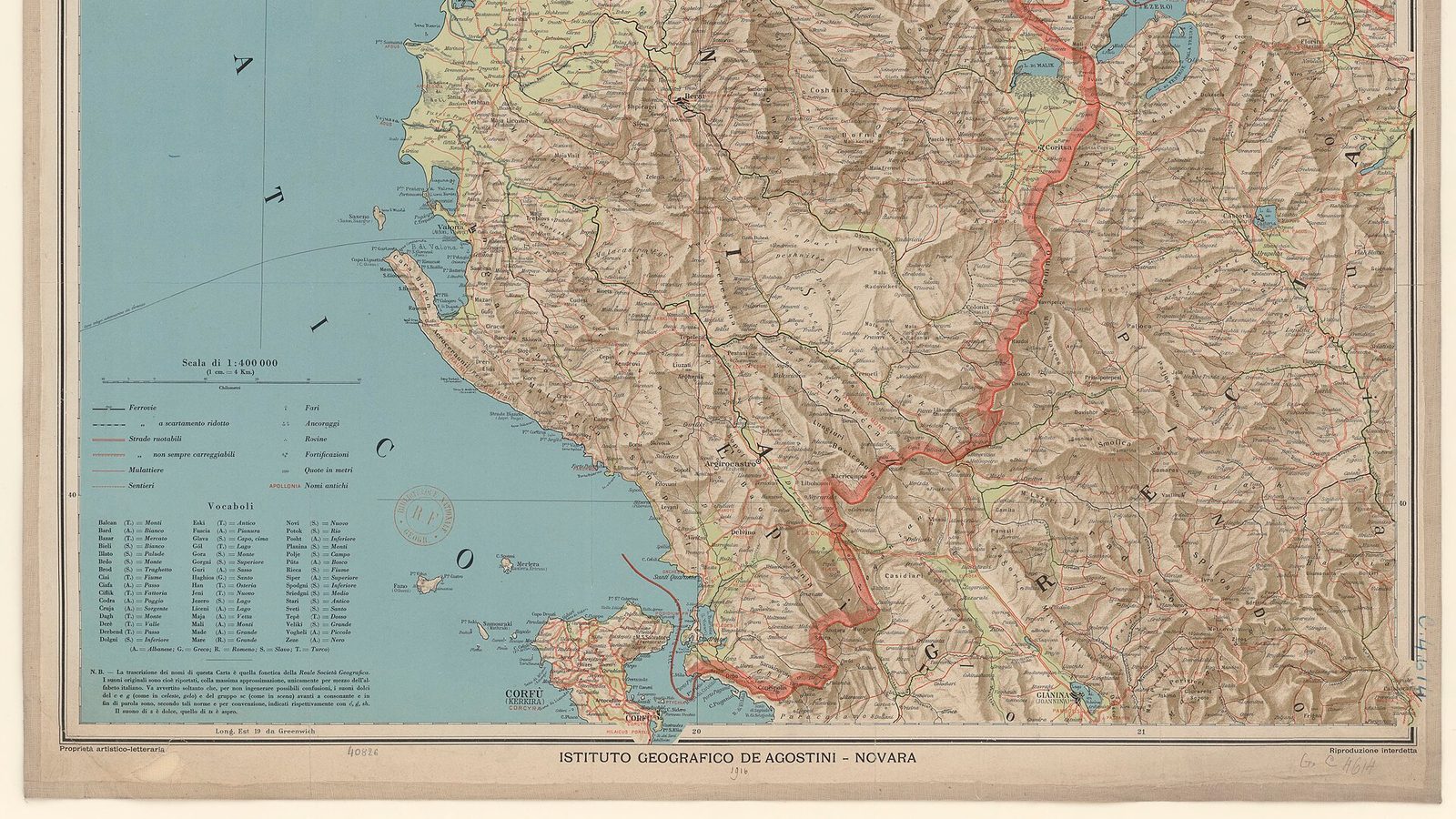
In the south, the ethnic Greek population of the regions around Gjirokastër and Korçë had already declared the Autonomous Republic of Northern Epirus on 28 February 1914 — a week before Wied even arrived. Greece, which had occupied the region during the Balkan Wars and only reluctantly withdrawn under Great Power pressure, supported the separatists. Greek irregular forces clashed with Albanian gendarmes. The Protocol of Corfu, signed on 17 May 1914, attempted a compromise: the Greek-speaking districts would receive cultural and religious autonomy within Albania. Neither side was satisfied. By the end of 1914, Greek forces had reoccupied the territory.
The center: the peasant revolt
In central Albania, a peasant revolt broke out in the spring of 1914, concentrated in the lowlands between Tirana, Kavajë, and Elbasan. The revolt was driven by rural Muslim communities who had little attachment to the idea of a Christian European prince and a secular European-style state. The rebels were led by Haxhi Qamili, a local figure who called for Albania’s return to Ottoman sovereignty, the reinstatement of Islamic law, and the replacement of the Albanian flag with the Ottoman flag. On 3 June 1914, the rebels gathered at Kavajë and issued their demands.
The revolt was not merely conservative nostalgia. The Ottoman system had provided a structure — courts, tax collection, local administration — that the principality could not yet replace. For farmers in the interior, the prince in Durrës was an abstraction; the loss of the familiar Ottoman order was concrete.
By midsummer, Qamili’s forces had advanced to within sight of Durrës. The Dutch-officered gendarmerie and a handful of loyalist Albanian fighters held the perimeter, but the principality’s survival was an open question.
The palace: Essad Pasha
The most dangerous threat came from inside the government. Essad Pasha Toptani, the minister of war, was simultaneously serving the prince and undermining him. Essad had his own power base in central Albania, his own armed followers, and his own foreign backers — Italy and, through a secret treaty, Serbia. He had established the Republic of Central Albania from Durrës the previous year as a rival to the provisional government, and his ambitions had not shrunk.
On 19 May 1914, after evidence of conspiracy became unavoidable, Dutch gendarmerie officers authorized an operation against Essad. Armed forces surrounded and shelled his house in Durrës. Essad surrendered, was arrested, and was expelled to Bari in southern Italy aboard an Italian warship. He never stopped plotting. From exile, he continued to direct his followers in Albania and signed the Treaty of Niš with Serbia in September 1914, a military alliance that gave Serbia political influence over Albanian affairs in exchange for Serbian support for Essad’s claim to power — a deal that had no legal standing but illustrated his priorities.
A world war ended the experiment
On 28 June 1914, Archduke Franz Ferdinand of Austria-Hungary was assassinated in Sarajevo. By August, Europe was at war. The Great Powers that had created the Principality of Albania now had other concerns entirely. Austria-Hungary and Italy, the two powers with the most direct interest in Albania, were focused on their own mobilizations. The promised financial support — already thin — stopped.
Wied held on through August, but his position was untenable. The peasant rebels controlled much of central Albania. The Greek-backed Northern Epirus movement held the south. His treasury was empty. His gendarmerie was outnumbered. The Powers that had installed him were fighting each other.
On 3 September 1914, Prince Wilhelm of Wied boarded a ship at Durrës and sailed for Venice. He did not formally abdicate — he left the door open for a return that would never come. The International Control Commission ceased to exist three days later. The principality dissolved.
What followed was worse
The collapse of the principality did not lead to an alternative Albanian government. It led to occupation and near-erasure.
During World War I, Albania was carved into zones controlled by foreign armies. Italy occupied Vlorë and the south. Serbia and Montenegro pushed into the north. Austria-Hungary held parts of the northeast. France established an autonomous zone around Korçë in 1916. Greece reoccupied the south. At the Paris Peace Conference after the war, several proposals circulated to partition Albania entirely — dividing it among Italy, Greece, and the new Kingdom of Serbs, Croats and Slovenes (later Yugoslavia).
Albania survived as a state because of two things: the stubbornness of Albanian delegates who traveled to Paris and lobbied the Powers, and the Congress of Lushnjë in January 1920, where Albanian leaders rejected the partition plans, declared a new government, and moved the capital to Tirana. The congress is the real political founding of the Albanian state as it exists today — the Vlorë declaration created the idea, and Lushnjë saved it.
What 1914 means for the diaspora
The Principality of Albania matters to Albanian Americans not as a success story but as an object lesson. The Great Powers were willing to create a state but not to sustain one. International recognition, without the institutional capacity to govern, was worth the paper it was printed on. A foreign prince chosen in London, with no connection to the country and no resources to build one, was a gesture, not a government.
The decade that followed — occupation, partition proposals, the near-death of Albanian sovereignty — is the period that produced the first significant wave of Albanian emigration to the United States. Families who arrived in Massachusetts, New York, Connecticut, and Michigan in the 1910s and 1920s were leaving a country whose existence was genuinely uncertain. The organizations they built in America — Vatra, the Albanian Orthodox Church in America, the community associations of Worcester and Boston — were not just diaspora institutions. They were preservation efforts for a nation that had no guaranteed future.
That experience — watching a state fail because it lacked the internal strength to survive — is embedded in Albanian-American civic culture. The instinct to organize, to count, to make the community visible and self-sufficient, comes in part from the generation that watched the principality collapse and the partition maps circulate. When NAR counts Albanian Americans today, it is continuing a project that began in the years when Albanian statehood was an experiment that had already failed once.
Timeline
| Date | Event |
|---|---|
| 29 July 1913 | Great Powers recognize Albanian sovereignty as a principality |
| 15 Oct 1913 | International Control Commission established |
| 21 Feb 1914 | Wilhelm of Wied accepts the Albanian throne |
| 28 Feb 1914 | Autonomous Republic of Northern Epirus declared in the south |
| 7 Mar 1914 | Wied arrives in Durrës aboard an Austro-Hungarian warship |
| 17 Mar 1914 | Turhan Pasha Përmeti forms the government |
| 17 May 1914 | Protocol of Corfu grants southern autonomy provisions |
| 19 May 1914 | Essad Pasha arrested and expelled to Italy |
| 3 Jun 1914 | Peasant rebels gather at Kavajë, demand return to Ottoman rule |
| 28 Jun 1914 | Archduke Franz Ferdinand assassinated in Sarajevo |
| 28 Jul 1914 | Austria-Hungary declares war on Serbia; WWI begins |
| 3 Sep 1914 | Prince Wied departs Durrës; principality collapses |