

1. The Story
There are stories a people keeps as an ornament, and stories it keeps as a wound. Rozafa is one of the second kind. Every Albanian knows it — even one who has never set foot in Shkodër, even one born far away, beyond the borders and beyond the seas. We carry it in the blood. Let us tell it once more, just as Mitrush Kuteli told it to us.
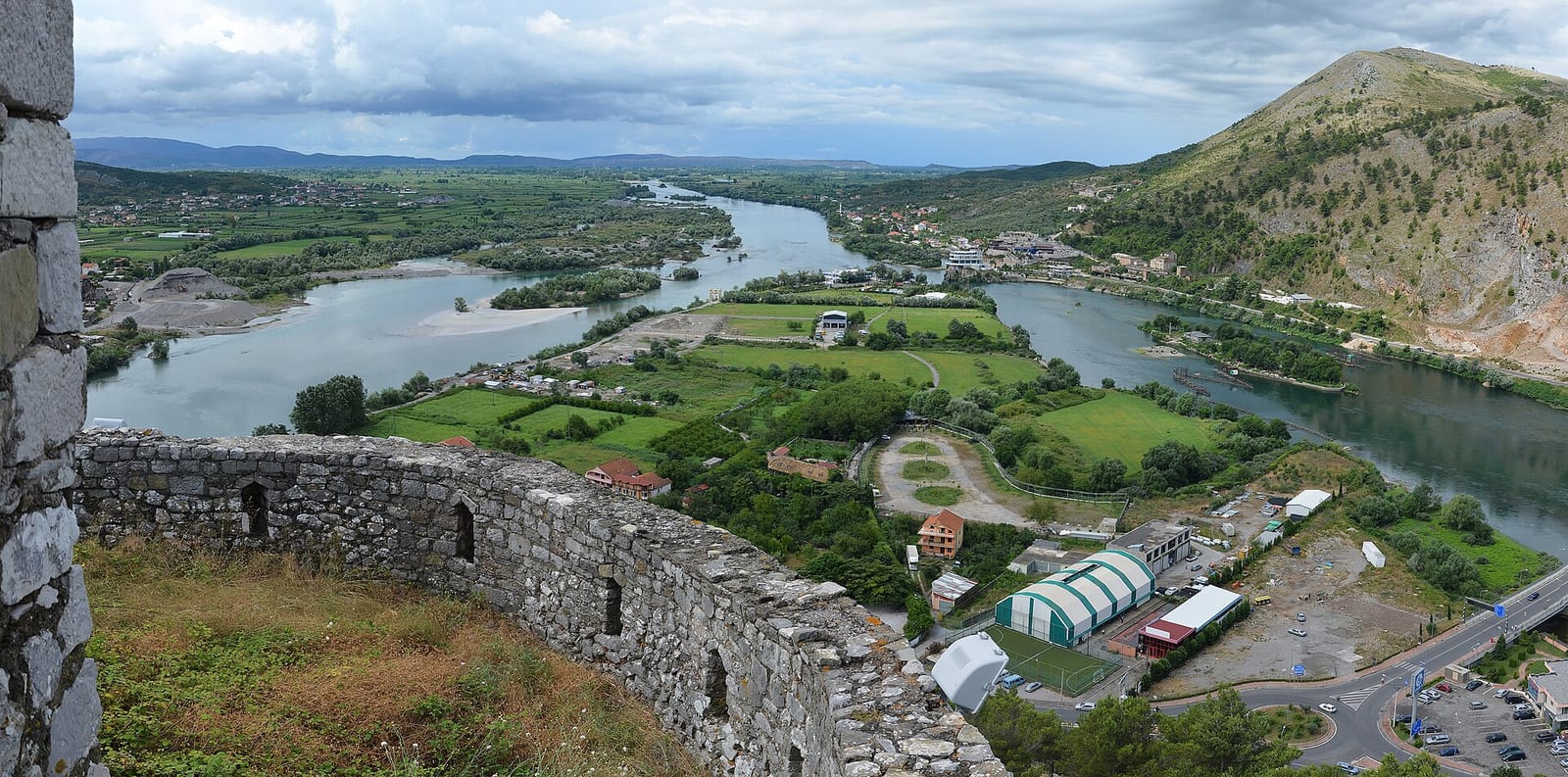
Proud above the wide Buna and above the city of Shkodër rises the ancient castle of Rozafat.
When was the first stone laid in the foundations of this fortress? No one knows. Its history is lost in the mist of Illyrian antiquity, among the old inhabitants of this land.
One thing is known, clearly and well: it once belonged to the Labeates and then to the Ardiaei, who were strong Illyrian tribes. In those days the whole near shore of the Adriatic, all the way to bustling Tergeste — the Trieste of our own day — was an Illyrian shore. Later the Romans poured in, then the Slavs, the Normans, the Venetians, the Turks, and many other foreign peoples. Over the centuries those dry crags beneath the walls of Rozafat, and the walls of the fortress themselves, have been soaked with streams of blood — the blood of those who attacked it and the blood of those who defended it. The strangers came and went; our people stayed, rooted in this Illyrian soil.
The mist fell upon the Buna and covered it whole. The mist lay there three days and three nights. After three days and three nights a thin wind blew and lifted the mist. It lifted it and carried it as far as the hill of Valdanuz. There, at the top of the hill, three brothers were at work. They were building a fortress. The wall they raised by day collapsed by night, and so they could not raise it at all.
A kind old man comes by.
— Good work to you, three brothers.
— Good fortune to you, kind old man. But where do you see our good fortune? By day we build, by night it falls. Do you know some good word to tell us — what can we do to keep the walls standing?
— I know — says the old man — but it is a sin for me to tell you.
— Cast that sin upon our heads, for we want this fortress to stand.
The kind old man thinks, and asks:
— Are you married, brave men? Do all three of you have your wives?
— We are married — they tell him. — All three of us have our wives. So tell us what we must do to make this fortress stand.
— If you want it to stand, bind yourselves with besa: tell your wives nothing, speak nothing at home of the words I am about to tell you. Whichever of the three sisters-in-law comes tomorrow to bring you bread, take her and wall her alive into the wall of the fortress. Then you will see that the wall will hold and stand for ever and ever.
So spoke the old man and went on his way: now he was seen, then he was seen no more.
Alas! The eldest brother broke his besa and his word. He spoke at home, told his wife so-and-so, told her not to come there the next day. And the middle brother too broke his besa and his word: he told his wife everything. Only the youngest kept his besa and his word: he spoke nothing at home, told his wife nothing.
In the morning the three of them rise early and go to work.
The hammers strike, the stones break, the hearts beat, the walls rise…
At home, the mother of the sons knows nothing. She says to the eldest:
— My eldest bride, the masons want bread and water; they want the gourd of wine.
The eldest bride answers her:
— By my besa, mother, today I cannot go, for I am ill.
She turns and says to the middle one:
— My middle bride, the masons want bread and water; they want the gourd of wine.
— By my besa, mother, today I cannot go, for I must visit my family.
The mother of the sons turns to the youngest bride:
— My youngest bride…
The youngest bride springs to her feet:
— At your command, lady mother!
— The masons want bread and water; they want the gourd of wine.
— By my besa, mother, I will go, but my son is small. I fear he will want the breast and will cry.
— Go, set out; we will watch over the child, we will not let him cry — say the sisters-in-law.
The youngest rises, the good one, takes bread and water, takes the gourd of wine, kisses her son on both cheeks, sets out and comes down to Kazena; from there she climbs the hill of Valdanuz, and draws near the place where the three masons are working: her two brothers-in-law and her husband.
— Good work to you, masons!
But what is this?
The hammers stop and do not strike, yet the hearts beat hard and harder. The faces go pale. When the youngest brother sees his wife, he throws the hammer from his hand and curses the stone and the wall. His wife says to him:
— What is wrong with you, my lord? Why do you curse the stone and the wall?
The eldest brother-in-law breaks in:
— You were born on a black day, our sister-in-law. We have sworn by our word to wall you alive into the wall of the fortress.
— Good health to you, my brothers-in-law. But I will leave you one request: when you wall me into the wall, leave my right eye out, leave my right hand out, leave my right foot out, leave my right breast out. For my son is small. When he begins to cry — with one eye I will watch him, with one hand I will caress him, with one foot I will rock his cradle, and with one breast I will give him to nurse. May my breast turn to stone, may the fortress stand, may my son grow brave, may he become a king and reign!
They take the youngest bride and wall her into the foundation of the fortress. And the walls rise, climb higher, and no longer fall as before. But at their foot the stones are wet and mossy to this day, because the mother’s tears go on dripping for her son…
And her son grew, and he fought, and he proved brave.
2. Why This Story Was Born
A people does not keep a story this heavy alive for pleasure. It keeps it because it serves. And to understand why we needed it, we have to remember what kind of life we lived.
We were, and we still are, a small people set at a geographic crossroads that everyone covets, and for that reason always under attack; a people that did not survive by empire, but by what it knew how to build and to hold: the tower, the bridge, the fortress, the clan. And in a life like that, where every stone was raised with toil and with blood, where the surest inheritance of an Albanian is suffering and the assault on daily life — whether from conquerors or from the country’s own systems of rule — one question follows every generation: why must we give so much for anything to remain to us?
Rozafa is an answer this people gives itself. It says: nothing that remains is raised for free; what stands forever stands because someone agreed to become its foundation. It is not a lie to soothe children; it is the harsh wisdom of people who knew the price of endurance and chose to pay it.
Let us say it plainly: everything that stands, stands upon a sacrifice. No wall rises with stones alone; it rises with something a person took from themselves and set into the foundation. This is how everything we call lasting has been built. The castle of Shkodër held through the great siege of 1478 because its defenders paid for the rock in blood, day after day — even though it was Venice, in the end, that ceded Shkodër to the Ottomans by treaty in 1479, not the defenders who lost it in battle. The Albanian family survived because the mother took the food from her own mouth to feed her children, and the father took the roads of exile far from home so the rest could stay together. Our language reached us because whole generations spoke it in secret when it was forbidden. This is the truth Rozafa tells us: nothing of worth comes for free, and whoever wants something to last beyond themselves must agree to give something. The bride did not build the castle with her hands; she built it by becoming the stone herself.
In its wisdom, the story gives us three lessons that remain irreplaceable: the iron weight of besa, the sanctity of the mother, and the need for the breath of youth that drives us forward. The brother who kept his word paid more dearly than anyone, and still he kept it — because where there was no state, the given word was the only law that held us together. A mother’s love is the foundation of the family, and the family is the foundation of the nation; without it, we are guaranteed that the stones we raise by day will fall in the night.
It is no accident that the heroine of this story is the youngest bride. Of the three, it is the youngest who goes, the one who carries new life at her breast, the one who finds courage when the men waver. When our people wove this story, they handed youth the key to the future: the foundation of a nation is not laid by those who are tired and grown used to evil, but by those who still have fire in their breast. No nation has moved forward without its youth; it is the young who refuse to accept the world as they found it, and that very refusal is the engine of all progress. As I write these words in the year 2026, the young men and women of Albania have taken to the streets, from Vlora to Tirana, to demand a fairer and cleaner country. Whatever each person may think of today’s politics, one thing stays clear as daylight: when youth gives up, the nation dies; when youth rises, the nation breathes. The youngest bride of Rozafa is their forebear. She reminds us that the future has always been entrusted to the one who has the most life to give, and that without the breath of youth the stones we raise by day will fall again by night.
3. What the Story Says, and Why It Still Moves Us
At its heart the legend says something as old as anything can be: the castle is not paid for with the bride’s life — it is brought to life by her. The damp wall is not a grave; it is a body that never stops giving milk. The wall does not take a life; it is given life and the strength to rise higher by the sacrifice of a heroine who, through this act, remains immortal and is woven forever into the core of the nation.
And so this woman is the heroine of the story. The men waver, they curse, they turn away their eyes; only she stands upright. She turns an execution into an act of love so great that she goes on being a mother even from the stone. We do not even know her name — Rozafa is the name of the castle, not of her — and still she stands higher than all the men upon that mountain.
Those openings for eye and breast, that stone which nurses and weeps, are the heart of this story. But honesty obliges us to set it in its place within its own Balkan family, because the ballad of the walled bride is sung the length of the peninsula, and not all of her sisters share the same ending. In the Greek Bridge of Arta, the woman is deceived into descending to the foundation to look for a ring, and then she curses the bridge and turns the curse into a blessing: there is no child there, no breast, no milk. Among the Romanians, master Manole walls in his wife, the pregnant Ana, and the song weighs on the tragedy of the builder, not on the mother who nurses. Among the Serbs, the Zidanje Skadra that Vuk Karadžić recorded is no other story — it is our own legend of Shkodër told in another tongue. The Bulgarians have the closest counterpart in the Kadin Bridge over the Struma, where the bride asks for that same window at the breast to feed her infant, and the stone drips milk to this day.
But our distinctiveness is not where we usually look for it. It is not that only the Albanians made a foundation sacrifice part of the national soul. Our distinctiveness is the form. Where the neighbors put the builder’s tragedy or the bride’s curse at the center, among the Albanians it is precisely the mother who nurses — the one who gives life from the wall — who became the foundation stone. That form we drove into the heart of our identity: retold by Mitrush Kuteli for every Albanian child, taught in every school, braided into the very name of the castle, Rozafat. The castle is not her grave; it is her last child. This is what is ours: not the motif, but the meaning we gave it.
That is why Rozafa is not a story we close in a book. It is a place we climb to. The damp stone is still shown to visitors as a mother’s milk; the legend is taught in every school, retold by Kuteli for every child, painted, carved, sung. The bride of Rozafa has become our national face of sacrifice for something greater than the self, and it runs through the way we have told our own history: a small people that survived by giving itself to the wall, so that the wall — that is, the nation — would stand.
4. In Its Time, and in Ours
Now let us face a question head-on, because it deserves it and because we are not afraid of it. A young Albanian today might say: but this is horrifying — three men raise a castle by walling in a woman. Read in passing, it is harsh; and it is harsh, but it is not only that.
We must understand what this story is and what it is not. It is not a rule for how we treat women, nor a boast that a woman’s life came cheap. It is a parable, born in a time of scarcity and siege, when every people of this region believed that nothing great would stand without a life in the foundation. In that world the story did not ask “whom can we sacrifice?” It asked “what are we ready to give in order to become its foundation?” — and it answered by making the bride not a victim but a hero. The order of that age, in which a woman had few choices and her name could be lost without ever being written down, we have left behind, and we did well to do so. We must take from the story what it always truly meant.
5. The Values It Gives Us
What, then, does Rozafa give to the soul?
It gives us besa — the conviction that the given word is a wall that must not fall, even when it costs us everything. It teaches us sacrifice for the common good, that the family, the clan, and the homeland outlast the life of a single person and are worth that life poured into them. It raises the mother and the hearth into sanctity. It teaches us endurance, that Albanian refusal to let the building fall, however heavy the siege. And it teaches us, in the end, the value of youth: that the new breath, the one not yet taught to surrender, is the hand that lays the foundation of tomorrow. Without it, none of the other values finds anyone to carry it forward.
6. The Place, the People, and the Trace That Was Never Erased
When you dig beneath an Albanian legend, time takes you down layer after layer, and every layer gives you the same answer: we have always been here.
When the story was born, we cannot date. But beneath it lies a belief older than writing: that a great work cannot stand without a life in its foundation. Edith Durham, when she walked our mountains around the year 1908, still saw the living shadow of this rite, when a ram or a black rooster was sacrificed into the foundations of a bridge or a tower. So beneath the legend lies a real and ancient practice. The earliest known written trace of the legend is not a folklore collection at all — it is the priest Marin Barleti, who set down its existence in 1505 in his Latin account of the siege, De obsidione Scodrensi. The version most Albanians know today comes from Mitrush Kuteli’s retelling. But the song was sung in our mountains long before any collector caught it in ink. The written page is simply the newest layer of the stone.
The people in the story — the three brothers and the bride — we find in no chronicle. They are not historical persons; they are types, the kind of people our land truly made: brothers who build as one hand, a people for whom the word weighs more than life. They are remembered, not recorded; they are faithful portraits of the world of the clan, of the tower, of the Albanian identity.
Rozafa rises where the Buna meets the Drin, above Shkodër. Its lowest stones were laid by the Illyrians; the city was called Skodra and was the capital of an Illyrian kingdom, where King Gent ruled until Rome defeated him in 168 BCE. A people that mints its own coin and keeps its king in a walled capital is a state, and it is ours, and it was here before Christ was born. Rome came, Byzantium came, the Balsha came, Venice came, the Ottoman came; and the great siege of 1478, when Shkodër held the rock against the army of Mehmet II, we know in detail because a son of this city, the priest Marin Barleti, lived it with his own eyes and left it in writing.
Stories like this are more valuable today than ever, because they remind us that we are an autochthonous people of these lands, and that Albanian is an ancient language, the most likely living continuation of Illyrian. Çabej, our great linguist, showed it patiently: the name Shkodër, as we say it, carries the sound-laws of Albanian, has come down mouth to mouth, unbroken, from them to us. The neighbors called it Skadar, Scutari — names taken late, from outside. We did not take it from anyone; we already had it. And here I must be honest once again, because the truth need not hide: Albanian is written only from the 15th century, so we argue the chain from the language, from the place-names, from the continuity of settlement, not from a dated letter. But the weight of the evidence, and the very word Shkodër on our lips, leads you home.
And now I lift my head from this wall and look to the north, because here begins what touches me most deeply. I see the line, that border they drew on the map in 1878 and in 1913 and cut this body in two. A little beyond is Ulqin, an Albanian city on the sea; there are Plava and Gucia; there are the mountains of Hoti, Gruda, Kelmend, Kastrat — tribes that still speak the Albanian of our grandfathers beyond the border and keep their own foundation legends. And the legend of the walled bride does not stay within that line: we find its trace among the Arbëresh of Italy, who fled five centuries ago and still sing of the lost homeland, and in Kosovo, and in the south. Rozafa does not belong to official Shkodër; it belongs to the whole nation — to the one whom the state divides, but not the blood, not the language, not the stone that drips. For a people’s body can be cut up with borders, but not its memory, so long as there is someone to keep its traces.
7. The Testimony of the World
There are cases where a motif truly passes from people to people, neighbor to neighbor, and there are cases where the same thought is born on its own among peoples who have never met, because the human heart is the same everywhere.
The belief that a building demands a life is among the most widespread in the world. Scholars have even given it a number in the great index of folk motifs: S261, “the foundation sacrifice” (Thompson). This index — the great work of the American folklorist Stith Thompson — is a giant catalogue that ranks thousands of motifs of the world’s stories and gives each one a code, so that scholars can trace where the same motif appears from one people to another. The fact that the foundation sacrifice has its own code means something simple but strong: this belief is not ours alone, but has been found almost everywhere in the world, from the Balkans to India and beyond. So the rite Durham saw in our mountains was no local oddity; it was the Mediterranean edge of a belief that has circled the earth.
And within the Mediterranean family, Rozafa has her own close sisters: the Bridge of Arta among the Greeks, the Monastery of Argeș with master Manole among the Romanians, the Kadin Most among the Bulgarians, the bridges of Mostar among the Bosnians, and a “Building of Shkodër,” Zidanje Skadra, that Vuk Karadžić recorded among the Serbs — about our own castle. Here the kinship is real, because these peoples have lived for centuries side by side. But our seal — the stone that nurses — remains ours.
The same wisdom the bride of Rozafa left us is found also in the books Albanians hold sacred. The Bible tells of foundation sacrifices and of Jephthah, whose daughter, like our bride, accepts her fate; the Gospel speaks of the stone the builders rejected that became the cornerstone, and of the grain of wheat that must fall and die in the earth to bear fruit. The Quran tells of the trial of Ibrahim, where the son accepts the sacrifice with patience and submission, and Muslim Albanians mark it every year at Kurban Bajram. But let us say it clearly: these values we learned neither from the religions nor from foreigners, because we had them centuries before these faiths came to us and millennia before globalism overran the earth. When the first Christian missionary or the first hoxha touched these lands, the walled bride had been nursing the castle in the mouth of the people for centuries. The sacred books gave us neither besa, nor sacrifice, nor a mother’s love; they simply found in us what we had known all along.
So I do not say that Albania is the only one that values these lessons. We share the ballad of the bride with our neighbors; the echo with the sacred books is explained by the fact that the human heart everywhere grasps the same great truths. What I say is simpler and stronger: our history, our identity, and our antiquity contain everything of worth for a meaningful life. The Albanian need not choose between the stories of his own people and the teachings of a sacred book, because both, on the things that truly matter, speak with one voice. And this corpus is not Rozafa alone: it is Gjergj Elez Alia, who rises from his deathbed for the honor of his sister and his land; it is Konstantin, who rises from the grave to keep the besa given to his mother; it is the whole epic of the kreshnikë, raised upon oath, hospitality, and self-giving. Our oral tradition is, in the truest sense, a moral scripture.
8. The Faith of the Albanian Is Albanianness
And here is what Pashko Vasa meant by those words we repeat without weighing them: the faith of the Albanian is Albanianness. He wrote them in the years of the League of Prizren, when they wanted us divided by house of worship, and he meant to call us above that division. He did not mean to take God from the human heart. He meant that the Albanian has an older floor beneath his feet: besa, the hearth, hospitality, sacrifice, a mother’s love — what our tradition has held since before the churches and the mosques were raised.
This castle was founded by the Illyrians and held in turn by Catholic, Muslim, and Orthodox hands, and what kept faith upon that rock for two thousand years was not the altar, but the word kept and the mother’s love built into the wall. The Catholic highlander before the living cornerstone, the Orthodox of the south before the grieving mother, the Sunni and the Bektashi who remember the sacrifice of Ibrahim — each finds in the bride of Rozafa the lesson his own faith teaches him too. This meeting is not a thinning of faith; it is the discovery of the common floor. And that floor, for us, has a name older than any church or mosque upon the rock: Albanianness.
And so we follow this trace, from Shkodër to Ulqin, from Çamëria to Arbëria, because a people that keeps its own traces is never lost. We need only one thing: to love this land a little more, and to teach our child, wherever they may be upon this earth, that each time they lay a hand upon the stone of Rozafa, they are Albanian.
Because we forget our stories, our myths, our legends and our tales — and with them our values — only at one price: the loss of ourselves. A people that no longer tells its children where it comes from very soon no longer knows who it is. The survival of Albanianness does not depend on borders or on the flag alone; it depends on these tales passing from our mouth to the mouth of our children, because with them pass also besa, honor, sacrifice, and love — the very core of being Albanian. So long as a mother tells Rozafa to her child, the castle stands. The day we stop telling it, the walls begin again to fall in the night.