

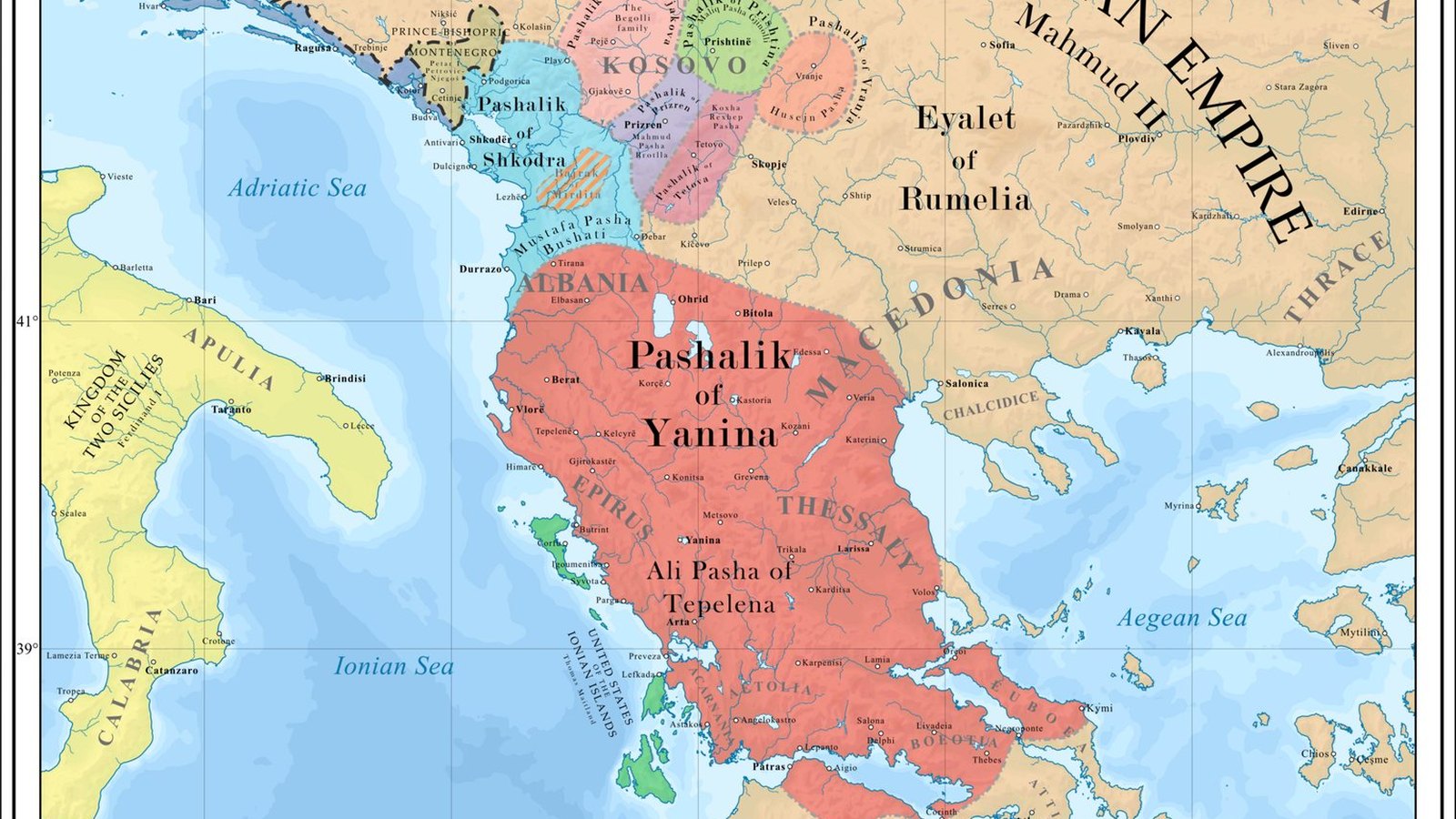
Before there was an Albanian state, there were Albanian states inside someone else’s empire.
For roughly 70 years — from the 1750s to the 1830s — Albanian Muslim strongmen governed territories so large and so autonomous that calling them Ottoman provinces misses what they were. They kept their own armies. They collected their own taxes. They fought their own wars, signed their own treaties, and dealt with the courts of Europe without asking Constantinople’s permission.
The two largest were the Pashalik of Shkodra, ruled by the Bushati family in the north, and the Pashalik of Ioannina, ruled by Ali Pasha of Tepelena in the south. Between them, a smaller Pashalik of Berat controlled central Albania under Ibrahim Pasha. At their peak, these three domains covered most of modern Albania, Kosovo, Montenegro, western North Macedonia, and much of northwestern Greece.
Then the sultan destroyed them both, reorganized the Albanian lands into four separate vilayets, and — without meaning to — set the stage for the Albanian national movement. The demand that defined the League of Prizren in 1878 was the demand for reunification: put the four vilayets back together into one Albanian province. That demand came from the memory of what the pashaliks had been — proof that Albanians could govern themselves.
What a pashalik was
The word pashalik (Turkish: paşalık) denotes the territory governed by a pasha — a high-ranking Ottoman official. In theory, pashas were the sultan’s appointees who served at his pleasure. In practice, by the 18th century, many pashas in the empire’s periphery had turned their governorships into hereditary fiefdoms. They paid nominal tribute to Constantinople, sent troops when summoned (or didn’t), and ran their provinces as personal domains.
Albanian pashas were not the only ones who did this — the Karaosmanoğlu family in western Anatolia and the Mamluks in Egypt operated under similar arrangements. But the Albanian case was distinctive in two ways. First, the terrain: the Albanian highlands were among the most militarily inaccessible regions in the Balkans, which gave local strongmen a natural fortress against central authority. Second, the social structure: Albanian tribal organization — with its emphasis on clan loyalty, armed households, and the code of besa — made the population difficult to govern without local intermediaries who understood the system from inside.
The result was that the Ottoman center often found it cheaper and easier to confirm powerful Albanian families as governors than to send in an outsider who would face immediate resistance. The Bushatis of Shkodra and Ali Pasha of Ioannina both exploited this dynamic to build personal states.
The Bushatis of Shkodra (1757–1831)
The Bushati family — also spelled Bushatlliu or Bushatli — came from the village of Bushat, about 10 kilometers south of Shkodra in what is now the Shkodra District of Albania. They were an Albanian Muslim noble family who held minor posts in the local Ottoman administration before Mehmed Pasha Bushati consolidated control of the Sanjak of Shkodra around 1757.
Mehmed Pasha Bushati (1757–1774)
Mehmed Pasha — known as Bushatli Mehmed Pasha Plaku (the Elder) — was the dynasty’s founder, proclaiming himself pasha of Shkodra in 1757. Sources differ on exactly when he consolidated power: some date his effective control of Shkodra to the late 1750s, others to the late 1760s. He secured appointment as governor of the Sanjak of Shkodra and gradually expanded his control over neighboring territories. He built a network of alliance and coercion that turned a provincial appointment into something closer to a principality. By the end of his rule in 1774, the Bushati name was the real authority in northern Albania.
Mustafa Pasha Bushati (1774–1778)
Mehmed’s son Mustafa succeeded him briefly, governing the pashalik from 1774 to 1778. His rule was a transitional period that maintained Bushati control before his brother Kara Mahmud took power.
Kara Mahmud Pasha (1778–1796)
Mehmed’s son Kara Mahmud Pasha (“Black Mahmud”) expanded the pashalik to its greatest extent. At its peak, his domain covered most of northern Albania, Kosovo, parts of western Macedonia, southeastern Serbia, and large swaths of Montenegro. He maintained his own army, collected taxes independently, and conducted foreign relations with Venice and Austria.
Kara Mahmud was aggressive where his father had been cautious. He launched multiple campaigns into Montenegro, burning the capital Cetinje in 1785 during a major invasion of the Prince-Bishopric of Montenegro. He fought to bring the highland clans under his authority and to project Shkodra’s power across the entire northern Albanian sphere.
His ambition outran his reach. In 1796, after his defeat at the Battle of Martinići, he launched a second campaign against the Montenegrin clans. At the Battle of Krusi on September 22, 1796, his forces were destroyed by the Piperi and Bjelopavlići clans. Kara Mahmud himself was killed in the fighting. The Montenegrins decapitated his body and sent his head to Cetinje as a trophy.
Ibrahim Pasha (1796–1810)
Ibrahim Pasha — Kara Mahmud’s brother — inherited a weakened position. Unlike his predecessor, he worked closely with the Ottoman central government, earning the title of Beylerbeyi (Governor-General) of Rumelia in 1805. He participated in the Ottoman campaign against the First Serbian Uprising and maintained stable relations with Constantinople. He governed until his death in 1810, passing a functional but diminished pashalik to the next generation.
Mustafa Pasha (1810–1831) — the last Bushati
Mustafa Pasha, Ibrahim’s nephew, was the dynasty’s final ruler. By the 1820s, Sultan Mahmud II had launched a comprehensive campaign to destroy autonomous provincial rulers across the empire — the same drive that ended the janissary corps in 1826 and Ali Pasha’s Ioannina in 1822.
In 1831, an Ottoman army under Grand Vizier Mehmed Reshid Pasha besieged Shkodra. Mustafa Pasha surrendered after the fall of Rozafa castle. The Bushati dynasty was finished. Seventy-four years of Albanian-led governance in the north ended with a siege and a surrender.
Ali Pasha and the south
While the Bushatis governed the north, Ali Pasha of Tepelena built a parallel state in the south. Appointed governor of the Sanjak of Ioannina in 1788, he spent the next 34 years assembling a domain that stretched from Berat in central Albania to the Gulf of Corinth in Greece.
Ali Pasha’s story is told in full in the dedicated article. What matters here is how his domain fit into the broader pattern: like the Bushatis, Ali exploited the gap between Ottoman central authority and local reality to build a personal state. At his peak he commanded an army estimated at up to 50,000 men. He maintained diplomatic channels with Napoleon, with the British, and with the Russians. He taxed, judged, and executed within his territory on his own authority.
The sultan tolerated Ali longer than most autonomous governors because Ali was useful — his domain served as a buffer against Greek and Napoleonic threats in the western Balkans. But when Sultan Mahmud II began his centralizing campaign, Ali became a target. In 1820, the sultan declared Ali a rebel. After a two-year siege, Ottoman agents killed Ali on January 24, 1822, on the island in Lake Pamvotis at Ioannina. His severed head was sent to Constantinople.
The Pashalik of Berat
Between the Bushati north and Ali Pasha’s south, a smaller Albanian pashalik existed in central Albania. Ibrahim Pasha of Berat governed from the fortress city of Berat, controlling the Musacchia plain and parts of the Vjosa and Devoll valleys. His domain was less famous than the other two, but it completed the picture: by the late 18th century, nearly all Albanian-inhabited territory was under the effective control of Albanian strongmen, even as it remained nominally Ottoman.
Ibrahim Pasha of Berat was eventually absorbed into Ali Pasha’s expanding southern domain in the early 1800s. Ali’s hunger for territory left no room for a third Albanian pasha between Ioannina and Shkodra.
What the pashaliks meant
The Albanian pashaliks mattered for three reasons that outlived the pashas themselves.
They proved Albanian self-governance was possible
For 70 years, Albanian rulers governed territories that functioned as states — with armies, tax systems, diplomatic relations, and internal administration. The pashas were autocrats, not democrats, and their subjects had no voice. But the fact of Albanian-run governance at scale created a precedent. When the Albanian national movement began in the 1870s, it did not have to argue from pure theory that Albanians could manage their own affairs. There was a living memory of exactly that.
They mapped the territory
The pashaliks outlined, roughly, the territory that Albanians would later claim as their national homeland. The Bushati pashalik’s northern reach into Kosovo and Montenegro, Ali Pasha’s southern reach into Epirus and Thessaly — these were not abstract ethnic claims. They were the boundaries of recent political control. The map of what the pashas held and the map of what the League of Prizren demanded shared a recognizable shape.
Their destruction created the administrative fragmentation that drove the national movement
When Sultan Mahmud II destroyed the Albanian pashaliks in the 1820s and 1830s, he replaced them with something worse for Albanian political coherence. The 1867 Vilayet Reform reorganized the Ottoman provinces into a new system of vilayets — and the Albanian-inhabited lands were split across four:
- Vilayet of Shkodra — northern Albania, parts of the Montenegrin frontier
- Vilayet of Kosovo — Kosovo, parts of the Sandžak, western Macedonia
- Vilayet of Monastir (Bitola) — southeastern Albania (Korçë, Gjirokastër region), western Macedonia
- Vilayet of Janina (Ioannina) — southern Albania (Labëria, Chamëria), Epirus, parts of Thessaly
No single vilayet was majority Albanian. The Albanian-speaking population was a minority or a plurality in each, mixed with Greek, Slavic, and Turkish populations. This was partly demographic reality and partly deliberate Ottoman design: a unified Albanian province would have been large enough and cohesive enough to demand autonomy — or to break away.
The League of Prizren, founded in June 1878 at Prizren in Kosovo, made the reunification of these four vilayets into a single Albanian administrative unit its core demand. The league’s platform — Albanian-language schools, Albanian-speaking officials, and a single Albanian vilayet — was a direct response to the fragmentation that followed the pashaliks’ destruction. The Ottoman government rejected the demand and suppressed the league by 1881. But the idea survived: one land, one administration, one Albanian province. It was the first clear articulation of what would become, 34 years later, the Albanian declaration of independence.
The Toptani and the lesser dynasties
The Bushatis and Ali Pasha were the headliners, but Albanian political power within the Ottoman system extended beyond two families.
The Toptani family of Krujë and Tirana controlled large estates across central Albania. They produced Essad Pasha Toptani, who would establish a short-lived Republic of Central Albania from Durrës in 1913–14, and Sadije Toptani, the mother of King Zog I. The Toptanis were not pashalik rulers on the Bushati or Ali Pasha scale, but they were the dominant landowning family in the Tirana-Durrës corridor and wielded political influence well into the 20th century.
The Vrioni family of Berat and the Vlora family of Vlorë were similarly prominent. The Vrionis produced several Ottoman-era governors and fought both alongside and against Ali Pasha at various points. The Vloras produced Ismail Qemali, who declared Albanian independence from Vlorë in 1912.
These families formed a layer of Albanian Muslim aristocracy that survived the end of the pashaliks and shaped the independence movement. The men who signed the 1912 declaration were, in many cases, the grandsons and great-grandsons of the men who had served under or alongside the pashas.
From pashaliks to nation
The Albanian pashaliks were not a national movement. The Bushatis did not fight for Albania — they fought for the Bushati family’s control of Shkodra. Ali Pasha did not fight for Albanian self-determination — he fought for Ali Pasha’s personal power in Ioannina. Neither ruler articulated an Albanian national identity or a program for Albanian political unity.
But they created the conditions in which such a program could form. Their territories gave Albanians a memory of self-governance. Their destruction gave Albanians a grievance: a fragmented people split across four provinces with no administrative voice. And their lesser-dynasty networks gave the independence movement its first leaders — men with the social standing, the Ottoman political experience, and the family connections to organize a national congress.
The line from the Bushati pashalik to the League of Prizren to the declaration of independence is not straight, but it is real. The pashaliks showed what Albanian power looked like. Their end showed what its absence cost. The national movement spent the next 80 years trying to get it back — and in 1912, it did.