

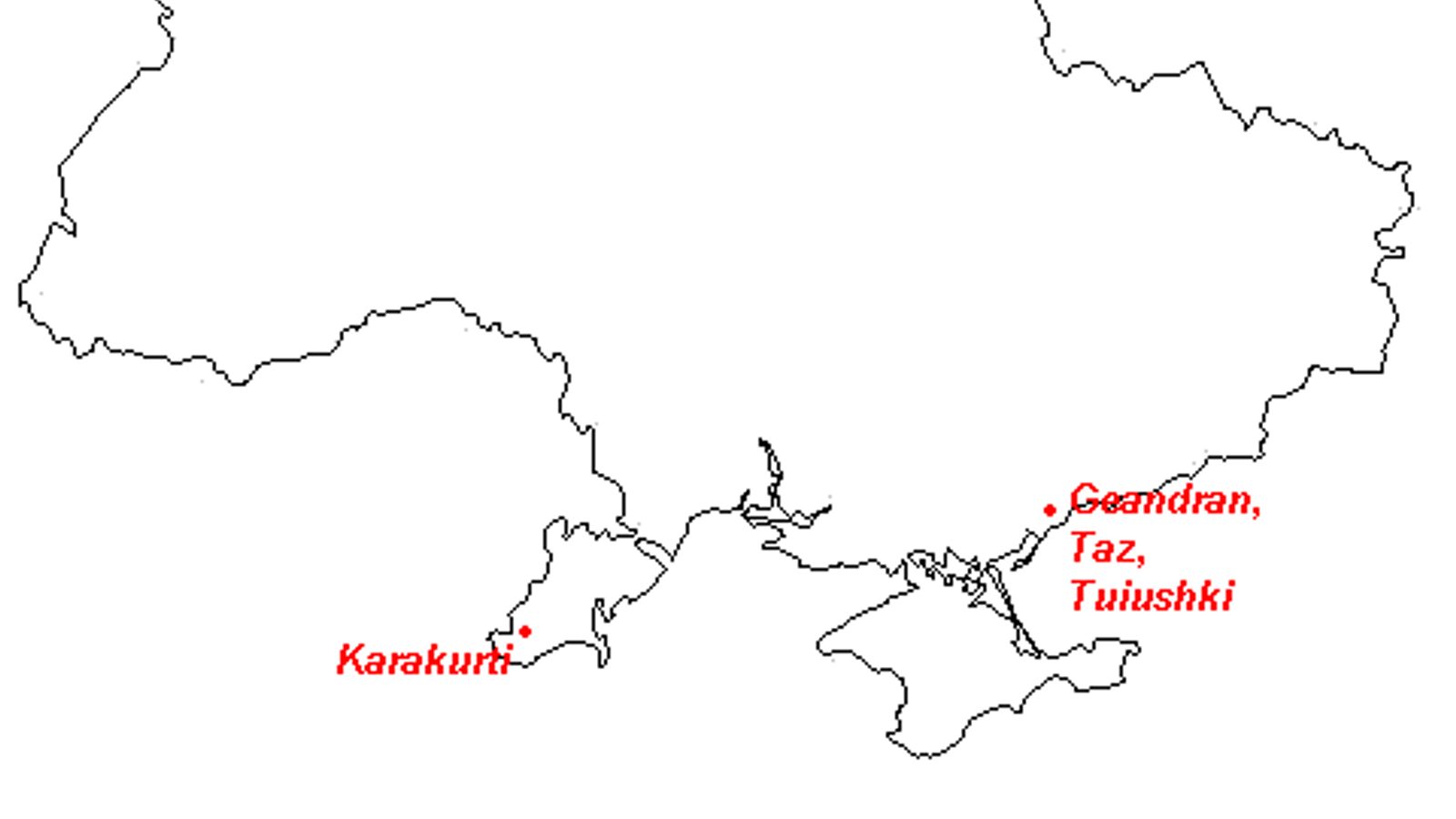
Ukraine is not a country most people associate with Albania. But four villages in the country’s south — one near the Moldovan border, three on the Azov steppe — have been Albanian-speaking for over two centuries. Their residents descend from Tosk Albanians who left the Korça region under Ottoman pressure, spent generations in Dobruja, and then settled in the Russian Empire’s frontier territories in the 1800s. As of the 2001 Ukrainian census, 3,308 people identified as ethnically Albanian. The broader Albanian diaspora includes communities across five continents; the Ukrainian chapter is one of the least known and, since February 2022, one of the most directly affected by war.
From Korça to Dobruja to Ukraine
The Albanian communities in Ukraine trace their origin to the Korça, Devoll, and Kolonja districts of southeastern Albania — all historically Tosk-speaking regions. Sometime in the fifteenth or sixteenth century, families began leaving for Ottoman-held Dobruja (present-day northeastern Bulgaria and southeastern Romania), joining the region’s mix of Bulgarians, Gagauz, Greeks, and Tatars.
The families stayed in Dobruja for roughly three centuries. The Russo-Turkish Wars of the late eighteenth and early nineteenth centuries created an opening. Orthodox Albanians who had served alongside the Russian military during the 1768–1774 war were permitted to settle in newly acquired Russian territories. Some moved to Odesa, where two streets — Mala Arnautska and Velyka Arnautska — still carry the word “Arnaut,” the Ottoman-era term for Albanians.
During the 1806–1812 Russo-Turkish War, a larger group of several thousand Orthodox Albanian families moved from Dobruja into Russian-controlled Bessarabia. In 1811, they founded Karakurt, a village in what is now the Bolhrad Raion of Odesa Oblast.
Half a century later, in 1862, a second wave of Albanian settlers moved from Bessarabia eastward to the Azov coastal steppe of Zaporizhzhia Oblast. They established three villages on former Nogai Tatar land: Georgievka (historically Tyushki), Devninske (Taz), and Gammovka (Dzhandran).
Karakurt
Karakurt is the largest and best-documented Albanian settlement in Ukraine. It sits in the Bolhrad Raion of Odesa Oblast, in the Budjak region near the Moldovan border. The village was renamed Zhovtneve on 14 November 1945 after the Red Army recaptured Bessarabia. It reverted to Karakurt on 12 May 2016 under Ukraine’s decommunization law.
As of recent counts, Karakurt has roughly 2,400 residents. In 2013, the village was approximately 60% Albanian, 25% Bulgarian, 10% Gagauz, and 5% other ethnicities. Albanian is the predominant language in daily life.
The village has two cultural institutions focused on Albanian heritage: the Rilindia (Rebirth) Albanian Cultural and Educational Association, active in Bessarabia for decades, and the Caracurt Center for Albanian Culture, which opened in 2016. Aleksandr Dermentli, a prominent figure in the local Albanian community, lives in Karakurt and has written a book on the village’s history, published first in Russian and later translated into Albanian.
The Priazovye villages
The three Zaporizhzhia villages — Georgievka, Devninske, and Gammovka — were founded in 1862 by Albanian families who moved from Bessarabia to the Azov coastal steppe. The villages sit on land formerly used by Nogai Tatars, whose old toponyms (Tyushki, Taz, Dzhandran) the settlements carried before receiving their current names.
The three villages are smaller than Karakurt. All three are smaller than Karakurt, with populations ranging from several hundred to under a thousand. Together with Karakurt, they account for the bulk of Ukraine’s ethnic Albanian population.
Under Stalin, the Albanian community was not subjected to mass deportation as a nationality — unlike, for example, Crimean Tatars. But individual Albanian families considered wealthy were deported to Siberia during the purges. According to community accounts, none returned.
An archaic Tosk dialect
The Albanian spoken in these villages is not standard Albanian. It is an archaic Tosk dialect that diverged from the language of Albania itself after roughly two centuries of separation. Linguists who have conducted fieldwork in the villages have mapped the dialect’s vocabulary and grammar against related varieties in southern Italy (Arbëresh), Greece, and Bulgaria.
The dialect preserves features that have disappeared from modern Albanian, including elements traceable specifically to the Korça, Devoll, and Kolonja districts. Its mythological vocabulary shows shared archaic roots with the Arbëresh of Italy and the Albanian communities in Greece.
According to the 2001 census, 52.6% of Ukraine’s Albanians reported Albanian as their native language, while 35.7% reported Ukrainian. Since the 2000s, teachers from Karakurt and Devninske have trained in Tirana and introduced standard Albanian instruction in village schools, running alongside the older dialect still spoken by older residents.
The war
On 24 February 2022, Russia invaded Ukraine. For the Albanian community, the invasion drew a line through the middle of their four villages.
Karakurt, in Odesa Oblast, has remained under Ukrainian control. The village has experienced periodic shelling but has not been occupied.
The three Priazovye villages — Georgievka, Devninske, and Gammovka — sit within the portion of Zaporizhzhia Oblast that Russian forces have occupied since early 2022. Melitopol, the nearest city, became the Russian-installed administrative center of occupied Zaporizhzhia in March 2023.
Ethnic Albanians from these communities have fought and died for Ukraine. Anatoliy Dermentli, born in Karakurt, served in Ukraine’s 118th Mechanized Brigade in Zaporizhzhia Oblast and was killed on 15 October 2023. Danylo Haydarzhy, born in Georgievka in 2002 into an Albanian family, was killed near Liman in Kharkiv Oblast after volunteering for the Armed Forces of Ukraine. Albanian media — Telegrafi, Euronews Albania, KosovaPress — have covered the community’s wartime experience, framing the Ukrainian Albanians as firmly pro-Ukrainian.
A community few know exists
Ukraine’s Albanian community numbers somewhere between 3,308 (the 2001 census figure) and 5,000 (community estimates). It is small by any measure. But it has preserved an archaic dialect for over two hundred years, maintained cultural institutions through Soviet rule and Ukrainian independence, and now faces a war that has physically divided its four settlements.
The Rilindia association, the Caracurt Center, and the Union of Albanians of Ukraine continue to maintain Albanian identity in a region where that identity exists alongside Ukrainian, Russian, Bulgarian, and Gagauz cultures. Whether the three occupied Priazovye villages will return to Ukrainian control — and what the dialect and community will look like when they do — is one of the unresolved questions facing Europe’s smallest Albanian diaspora.