

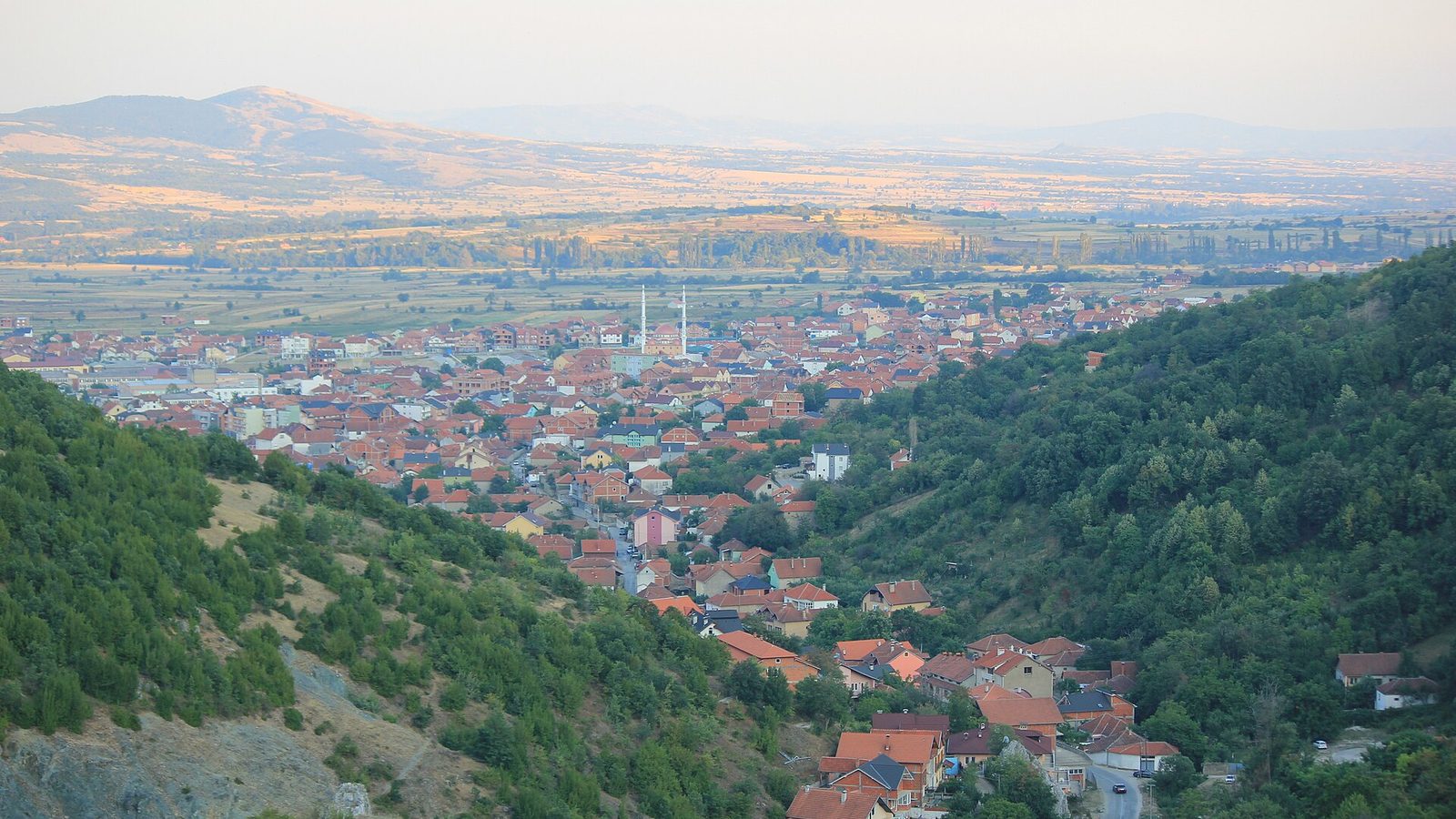
The 1945 Yugoslav border redraw assigned three Albanian-majority municipalities — Preševo, Bujanovac, and Medveđa — to Central Serbia rather than to the newly created Autonomous Oblast of Kosovo. Eight decades later, their Albanian population is still there: roughly 62,000 people by the 2022 Serbian census, holding schools, mosques, and local councils in a strip of land wedged between Kosovo and North Macedonia.
This is the story of a community that ended up on one side of an administrative line drawn for Yugoslav-era reasons and has lived with the consequences since — through Tito’s federation, Milošević’s crackdowns, a guerrilla insurgency, and an ongoing political struggle that connects directly to Albanian Americans in the United States.
The Preševo Valley is not Kosovo, and it is not the broader Serb-Albanian conflict, though it touches both. It is its own place with its own history, and that history deserves its own telling.
How the border got drawn
Before 1912, the Preševo region was Ottoman territory, part of the Kosovo Vilayet. The First Balkan War transferred it to Serbia. Under the interwar Kingdom of Yugoslavia, the area was governed from Belgrade. Its Albanian residents — farmers, merchants, and tradespeople — had no autonomy and limited schooling in their own language.
The border that defines the Preševo Valley today was drawn in 1945–46, when Tito’s communist partisans reorganized Yugoslavia into six republics and two autonomous provinces. Kosovo became an autonomous region within Serbia. Preševo and Bujanovac, which had briefly been part of the new autonomous oblast, were reassigned to Central Serbia, along with neighboring Medveđa.
The reasoning was administrative and strategic, not ethnic. The result left a compact Albanian population outside the one Yugoslav entity — Kosovo — that was supposed to represent Albanian interests within Serbia. (Kosovo’s northern border was later modified in 1959, when the municipality of Leposavić was added to Kosovo — a separate adjustment often conflated with the original 1945 reorganization.)
For most of the Tito era, this mattered less than it would later. The 1974 Yugoslav constitution gave Kosovo near-republic status, and Preševo Valley Albanians could cross into Kosovo freely — for school, for work, for family. The border was a line on a map, not a checkpoint.
That changed in 1989, when Slobodan Milošević revoked Kosovo’s autonomy. Overnight, the distinction between “Kosovo” and “Central Serbia” hardened from an administrative category into a political one. Albanians in the Preševo Valley found themselves not just outside Kosovo but outside any institutional framework that recognized their existence as a community.
The demographics on the ground
The 2022 Serbian census counted 61,687 ethnic Albanians nationally, roughly 0.9% of Serbia’s population. Almost all of them live in the three Preševo Valley municipalities:
- Preševo — about 94% Albanian (31,340 of 33,449 residents in 2022), the political and cultural center of the community. The town’s main square carries Albanian-language signage, and the municipality has had Albanian-majority governance since multiparty elections began.
- Bujanovac — about 62% Albanian (25,465 of 41,068 in 2022), with a significant Serb minority and a smaller Roma population. The ethnic mix makes Bujanovac the valley’s most politically contested municipality.
- Medveđa — about 14% Albanian by the 2022 census (905 of 6,360 residents), down from roughly 30% in 2002. Emigration has hit Medveđa hardest; the municipality has lost population steadily since the 1990s.
These figures carry the same caveat that shadows Albanian population data everywhere in the Balkans: they are almost certainly an undercount. Many residents distrust Serbian state institutions and decline to participate. Others emigrated before census day — to Kosovo, to Western Europe, to the United States — and are no longer present to be counted. Community organizations in the valley estimate a total Albanian population closer to 80,000–100,000 if recent emigrants and their children are included.
The demographic trend line is concerning. Medveđa’s Albanian population has dropped by half since the 1980s. Even Preševo, where Albanians remain an overwhelming majority, has been losing young people to Prishtina, Tirana, and Western Europe at rates that threaten the community’s long-term sustainability in place.
The 1999–2001 insurgency
The Kosovo War of 1998–99 ended with NATO’s intervention and the withdrawal of Serbian military and police forces from Kosovo. But the Preševo Valley, though it shared a border with Kosovo and an overwhelmingly Albanian population, was not Kosovo. It stayed under Serbian sovereignty.
NATO established a Ground Safety Zone (GSZ) — a five-kilometer buffer strip along the Kosovo-Serbia administrative boundary — where Serbian military operations were restricted. The zone covered much of the Preševo Valley. Into that security vacuum stepped the UCPMB (Ushtria Çlirimtare e Preshevës, Medvegjës dhe Bujanocit — the Liberation Army of Preševo, Medveđa, and Bujanovac), an ethnic Albanian guerrilla force modeled on the Kosovo Liberation Army that had fought in Kosovo itself.
The UCPMB insurgency ran from mid-1999 to mid-2001. At its peak, the force numbered roughly 1,500 fighters, drawn from local men and some KLA veterans. They attacked Serbian police posts, staged ambushes on roads connecting the three municipalities, and sought to make the valley ungovernable under Serbian authority — the same strategy the KLA had used in Kosovo, aimed at internationalizing the conflict and forcing a political settlement.
The international community — especially the United States — did not support the insurgency. Washington pressured both sides toward negotiation, and in May 2001, the Končulj Agreement ended the fighting. Under its terms, Serbian forces were allowed to re-enter the GSZ in phases, the UCPMB demobilized, and Belgrade committed to a package of political reforms including greater Albanian representation in local governance, police, and courts.
The agreement held. The UCPMB disbanded. But the political reforms it promised were implemented slowly and unevenly — a pattern that would define the next two decades.
Life after the agreement: what changed and what didn’t
The Končulj Agreement stopped the shooting. What it did not do was resolve any of the structural problems that Albanian communities in the Preševo Valley face.
Education remains the most visible daily struggle. Albanian-language schooling exists but operates under severe constraints. Textbooks arrive late or not at all. Diplomas from the Albanian-language stream are not always recognized by Serbian universities or employers, which pushes families toward either Serbian-language schooling — at the cost of cultural identity — or sending children to Kosovo for secondary and university education.
Public employment tells its own story. Albanians are underrepresented in police, judiciary, and civil-service positions relative to their population share, despite the Končulj Agreement’s explicit commitments. Serbian remains the dominant administrative language, and Albanian-language access to courts and municipal offices is inconsistent.
Address “passivization” — the bureaucratic deregistration of Albanian residents from municipal rolls — has been a persistent complaint. Families who left temporarily during the 1999–2001 period returned to find their addresses canceled, cutting them off from property registration, voter rolls, and social services. The process is technical, but its effect is demographic: it shrinks the recorded Albanian population on paper, which in turn reduces the community’s claim to proportional representation.
Infrastructure tells its own story. The Preševo Valley sits on the European corridor connecting Belgrade to Skopje and Thessaloniki, but its municipalities have seen less public investment than comparable Serbian towns. Road quality, water infrastructure, and public buildings lag. The pattern is visible enough that international monitoring bodies — including the European Commission’s annual Serbia progress reports — have noted it repeatedly.
The land-swap proposal that went nowhere
In 2018, Serbian President Aleksandar Vučić and then-Kosovo President Hashim Thaçi floated a proposal that would have redrawn the border between Serbia and Kosovo along ethnic lines. The Preševo Valley — Albanian-majority — would transfer to Kosovo. The northern Kosovo municipalities around Mitrovica — Serb-majority — would transfer to Serbia.
The proposal generated intense debate. The European Union and most Balkan governments opposed it on the grounds that ethnic partition in the Balkans sets a precedent that could unravel borders across the region — in Bosnia, in North Macedonia, wherever mixed populations share territory. Germany was among the most vocal opponents. The United States under the Trump administration took a different line: National Security Advisor John Bolton said Washington would not object if the two parties reached an agreement themselves. But EU opposition, combined with resistance from within both countries, effectively shelved the idea.
Within the Preševo Valley itself, opinion was divided. Some Albanian leaders saw it as the only realistic path to unification with Kosovo. Others feared that a swap negotiated between two presidents, without local consent, would treat their community as a bargaining chip — transferred for strategic reasons in 2018 just as they had been in 1945.
The idea has not been formally revived, but it has not disappeared. It surfaces in diplomatic conversations about the Serbia-Kosovo normalization dialogue, which remains unresolved as of 2026.
The US connection
Albanian families from the Preševo Valley have been part of the broader Albanian-American migration for decades. They settled in the same metro areas — New York, Detroit, Chicago — as Albanians from Kosovo, Albania, and North Macedonia, and they participate in the same civic organizations, mosques, and cultural associations.
What distinguishes the Preševo Valley diaspora is its political focus. Because the valley’s Albanians live under Serbian sovereignty — unlike Kosovo Albanians, who now have their own republic — their advocacy in Washington carries a different ask. It is not about recognition of a new state. It is about human rights, minority protections, and accountability for discrimination within an existing one.
That advocacy has kept the issue on the congressional radar. The Congressional Albanian American Caucus has raised the Preševo Valley in hearings and letters to the State Department for years, pressing for assessments of discrimination against ethnic Albanians in Serbia — covering education access, employment, property rights, and political representation. These are the same categories that Končulj was supposed to fix more than two decades ago.
What the count shows and what it misses
The 2022 Serbian census figure — 61,687 ethnic Albanians — is a data point, not a portrait. It tells you how many people checked the Albanian box on a form administered by a state that many of them distrust. It does not tell you how many left before count day, how many declined to participate, or how many of their US-born children still identify as Albanian in American surveys.
The Albanian-American community includes families whose roots trace to Preševo and Bujanovac as surely as to Prishtina or Tirana. They carry the same language, the same traditions, and the same frustration at being undercounted — on both sides of the Atlantic.
The Preševo Valley is small. Three municipalities, a combined population under 100,000, in a strip of land most maps don’t label. But the questions it raises — about borders drawn without consent, about minorities who hold on across generations, about what a census captures and what it drops — are the same questions that define the Albanian experience from Chamëria to Michigan. What happens in Preševo is not a footnote to the Kosovo story. It is a chapter of its own.