

Durrës sits on a peninsula jutting into the Adriatic, 33 kilometers west of Tirana. It is Albania’s second-largest city, its busiest port, and its oldest continuously inhabited settlement — founded 2,600 years ago, roughly eight centuries before Albania existed as a concept and twenty-six centuries before it existed as a state.
The city has had four names. Greek colonists called it Epidamnos. Romans called it Dyrrhachium. Italians called it Durazzo. Albanians call it Durrës. Each name marks a layer of the city’s history, and all four layers are still visible — in the amphitheater half-buried under apartment blocks, in the Byzantine walls that frame the old city, in the Venetian tower that anchors the harbor, and in the port where ferries still cross to Italy on the same sea route the Romans used.
For where Durrës fits among Albania’s historic cities, see the cities of Albania overview.
Epidamnos: the Greek colony
In 627 BC, colonists from Corinth and Corcyra (modern Corfu) founded Epidamnos on the Albanian coast. The exact relationship between the two founding cities is debated by ancient sources — Thucydides says the colony was Corcyrean with a Corinthian founder-leader (oikistes), while other traditions give Corinth the primary role. What is not debated is the date or the location: the settlement occupied a defensible peninsula on the Adriatic, with a natural harbor on each side.
Epidamnos grew into a prosperous trading city, positioned on the sea route between Greece and Italy. It sat at the southern end of the Illyrian coast, where Greek maritime commerce met the Illyrian interior. The city traded with both worlds — Greek goods moved inland through Epidamnos; Illyrian agricultural products and minerals moved out through its port.
In 435 BC, a civil conflict inside Epidamnos between democratic and oligarchic factions triggered a chain of events that Thucydides identifies as one of the proximate causes of the Peloponnesian War. The democratic faction appealed to Corcyra for help; rebuffed, they turned to Corinth. Corcyra and Corinth went to war over the colony, and Athens was drawn in on Corcyra’s side. The fighting at Epidamnos was a curtain-raiser for the wider Greek world war that followed.
Dyrrhachium: Rome’s gateway to the East
Rome took the city in 229 BC during the First Illyrian War, fought against Queen Teuta of the Ardiaei. Under Roman rule, the city was renamed Dyrrhachium (or Dyrrachium) and became one of the most important ports in the empire — not because of what it produced but because of where it stood. Dyrrhachium was the closest major harbor on the eastern Adriatic to the Italian coast, separated from Brundisium (modern Brindisi) by roughly 200 kilometers of open sea.
That geographic fact made Dyrrhachium the hinge of Rome’s connection to its eastern provinces. In the 2nd century BC, after the conquest of Macedonia, Rome built the Via Egnatia — a military highway running roughly 1,120 kilometers from Dyrrhachium eastward through Thessaloniki to Byzantium (later Constantinople). The road began at the port of Dyrrhachium because that is where travelers arriving from Italy stepped onto Balkan soil. For centuries, the standard route from Rome to the eastern empire was: overland to Brundisium, ship across the Adriatic, disembark at Dyrrhachium, and walk the Via Egnatia east.
Cicero passed through Dyrrhachium during his exile in 58 BC. Pompey fortified the city and made it his base during the civil war with Julius Caesar. In 48 BC, the Battle of Dyrrhachium saw Caesar attempt to besiege Pompey’s larger army behind a line of fortifications south of the city. Caesar lost the engagement — one of his rare tactical defeats — before the campaign moved south to its conclusion at Pharsalus.
The city’s Roman-era population may have reached 30,000 to 40,000. The most visible evidence of its scale is the amphitheater.
The amphitheater
The Durrës amphitheater was built in the 2nd century AD, most likely during the reign of Trajan (r. 98–117) or Hadrian (r. 117–138). With an estimated capacity of 15,000 to 20,000 spectators — sources vary, and part of the structure remains unexcavated — it was one of the largest amphitheaters in the Balkans and among the larger ones in the Roman world outside Italy.
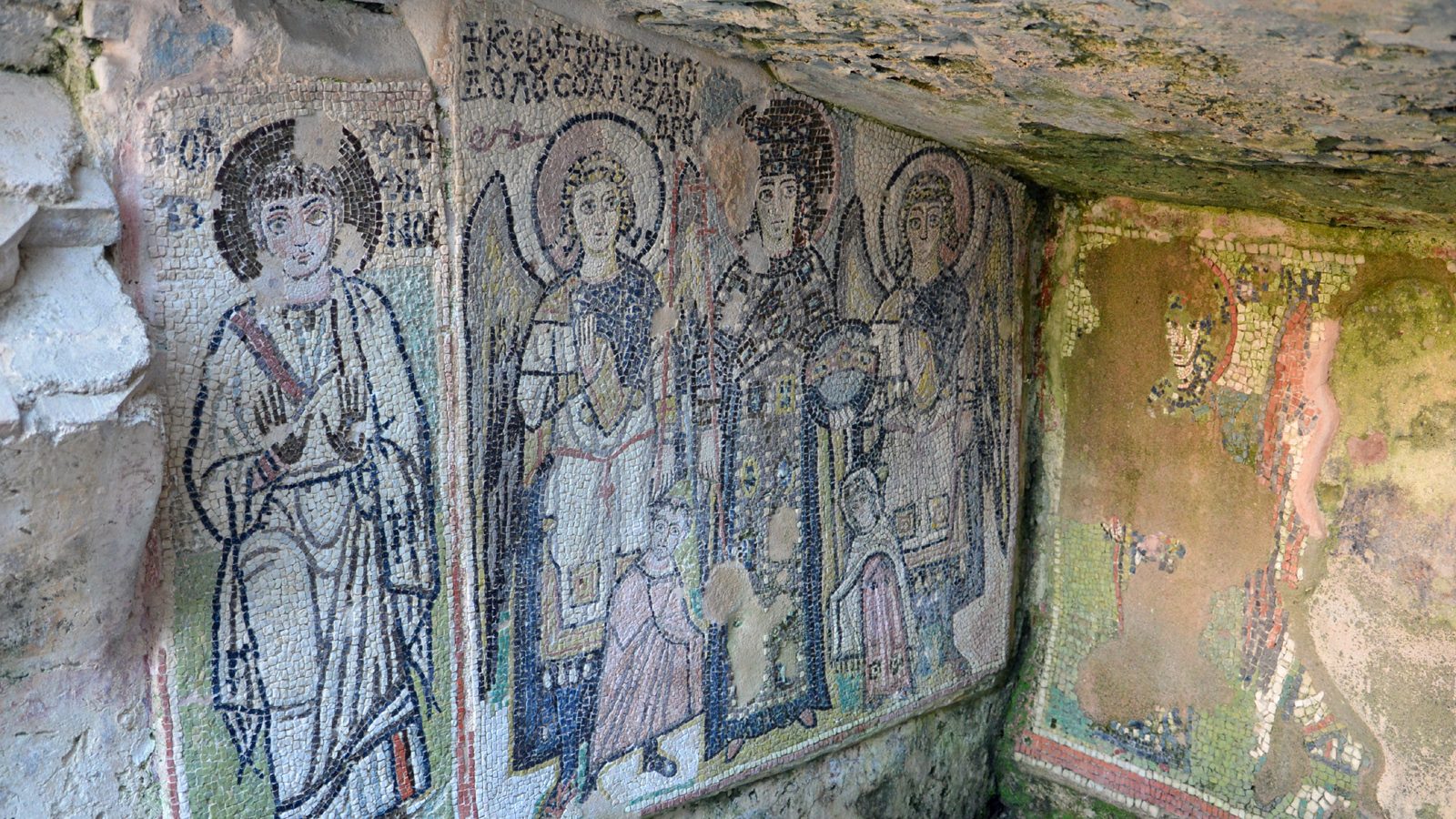
The amphitheater was buried and forgotten for centuries. In 1966, Albanian archaeologist Vangjel Toçi identified the site during construction activity in the area. Excavations revealed the arena, the seating vaults (vomitoria), and a remarkable addition: a small early Christian chapel built into one of the amphitheater’s galleries in the second half of the 4th century AD. Wall mosaics were added to the chapel in the 6th century. The chapel contains mosaics and frescoes depicting saints and religious scenes — among the rarest early Christian artworks in Albania and one of the few known examples of a chapel built inside a Roman arena.
The amphitheater is on Albania’s tentative list for UNESCO World Heritage status. Only about one-third of the structure has been excavated; the rest lies under the residential neighborhood that grew over it. The exposed sections are open to visitors, and the chapel mosaics are visible, though conservation remains a challenge — the site is partially exposed to weather, and the surrounding urban development complicates large-scale excavation.
Byzantium, the Normans, and the battles for Dyrrhachium
When the Roman Empire split in AD 395, Dyrrhachium fell on the eastern side — Byzantine territory. The city became the capital of the Theme of Dyrrhachium, one of the empire’s administrative-military provinces, and the anchor of Byzantine authority on the Adriatic coast. The walls built and rebuilt during this period — sections of which still stand in the old city — reflected the city’s strategic importance and its vulnerability to attack from the west.
The most consequential of those attacks came in 1081. Robert Guiscard, the Norman Duke of Apulia, crossed the Adriatic with an army and besieged Dyrrhachium. Emperor Alexios I Komnenos marched to relieve the city. The Battle of Dyrrhachium (1081) — fought on October 18 outside the city walls — ended in a Norman victory. Guiscard took the city, but the Byzantines under Alexios recaptured it around 1083. Guiscard died in 1085 while campaigning in Greece.
The Norman assault on Dyrrhachium was not an isolated raid. It was part of a pattern: the city’s position at the western end of the Via Egnatia made it the natural beachhead for any western power that wanted to march on Constantinople. Guiscard’s son Bohemond would besiege the city again in 1107–1108 during a failed campaign against Alexios.
The medieval contest for Durrës culminated in the establishment of the Kingdom of Albania under Charles of Anjou in 1272. Durrës served as the capital of the Angevin Regnum Albaniae — the first political entity to carry “Albania” in a formal kingdom title. The Angevin period and the kingdom’s century-long rise and fall are covered in the linked article.
Ottoman Durrës
The Ottoman Empire took Durrës in 1501, completing the conquest of the Albanian coast that had begun with Shkodra’s fall in 1479 and Skanderbeg’s death in 1468. Under Ottoman rule, the city shrank. Its population declined as maritime trade shifted to other ports, and repeated earthquakes — including severe ones in 1273 and later in the Ottoman period — damaged its infrastructure. The Ottomans built a mosque attributed to Fatih Sultan Mehmed inside the city walls, but Durrës was a provincial backwater compared to its Roman-era importance.
The city’s fortunes changed in the late 19th century when the Ottomans upgraded its port facilities. By the time Albania declared independence in 1912, Durrës was one of the country’s three significant coastal cities alongside Vlorë and Shkodër.
The 20th century: capital, port, and front line
Durrës served briefly as Albania’s capital. During the Balkan Wars, the city was the seat of the International Commission of Control — the body the Great Powers established to oversee the new Albanian state. In March 1914, Prince William of Wied arrived in Durrës to take up his appointment as head of the Principality of Albania. He governed from Durrës for six months before war and revolt forced his departure in September 1914.
During the Italian occupation of Albania (1939–1943), the port of Durrës was a key logistical hub. In World War II, the city was bombed by Allied aircraft targeting the port facilities. After the communist takeover in 1944, the regime invested in Durrës as an industrial and port city — Albania’s main sea link to the outside world during the decades of isolation under Enver Hoxha.
The post-communist period brought a population surge. When movement restrictions were lifted in the early 1990s, tens of thousands of Albanians from the rural interior migrated to Durrës and its surroundings, drawn by the port, the proximity to Tirana, and the Adriatic coast. The city’s population grew from roughly 85,000 in 1989 to an estimated 200,000 or more in the greater metropolitan area today, making it Albania’s second-largest city after Tirana.
Durrës today
Modern Durrës is a port city, a beach city, and an archaeological city occupying the same space. The ferry terminal handles passenger and cargo traffic to Bari and Ancona in Italy — the same Adriatic crossing that connected Dyrrhachium to Brundisium two millennia ago. The waterfront promenade runs along the Adriatic south of the port. The old city center, compact and walkable, sits on the peninsula where Epidamnos was founded.
The Archaeological Museum of Durrës, one of the largest in Albania, holds artifacts spanning the city’s full chronological range — Greek pottery, Roman statuary, Byzantine coins, and finds from the amphitheater excavations. The Royal Villa (Vila Mbretërore), built for King Zog in the 1930s on a hillside above the city, overlooks the port and the sea.
The Byzantine city walls — rebuilt multiple times from the 5th century through the medieval period — frame the old city. The Venetian Tower (Kulla Veneciane), a 14th-century fortification near the harbor, is one of the city’s most recognizable landmarks.
Durrës was hit hard by the November 2019 earthquake — a 6.4-magnitude event with an epicenter near Mamurras, roughly 30 kilometers west of Tirana, that killed 51 people nationwide, the majority of them in the Durrës area. The earthquake collapsed several multi-story buildings, damaged older structures in the city center, and prompted an international reconstruction effort. Some of the damage, particularly to Ottoman-era buildings, remains visible.
For the Albanian-American diaspora, Durrës is more departure point than destination. The port has been the place where generations of Albanians have boarded ships west — to Italy, and from there to the United States. The city itself does not have the concentrated diaspora identity that Shkodra, Korçë, or the Kosovo cities carry, partly because Durrës has always been a transit city: a place people pass through on their way somewhere else, and have been doing so since a Greek ship first dropped anchor 2,600 years ago.